Why High-Intensity, Low-Impact Training Becomes Essential After 35
Somewhere around 35, your body changes the rules without telling you.
The workout you used to do, the one that made you feel sharp and strong in your 20s, suddenly takes longer to recover from. You sleep less well after a hard session. The pounds you used to drop in a week now hold on for a month. Your knees have an opinion about leg day. And the cumulative weight of a real career, a real household, and a real calendar leaves you with less patience for any program that demands an hour of bouncing around to feel like it counted.
None of this is a personal failing. It is biology. And the good news, if we can call it that, is that the type of training that actually serves your body in this decade looks completely different from the one that served you in your 20s. It is quieter. It is shorter. It is more deliberate. And it works better.
Here is what is happening, why it matters, and what to do about it.
What actually changes in your body after 35
The shift is gradual, which is part of why it sneaks up on you. By your mid-30s, several things are happening at once:
Lean muscle starts leaving without permission
Sarcopenia, the age-related loss of muscle mass, can begin as early as your 30s and accelerates without resistance training. The American College of Sports Medicine notes that adults can lose 3 to 8 percent of muscle mass per decade after 30, and the rate increases after 60. Less muscle means slower metabolism, lower strength, and more fatigue.
Bone density begins its slow decline
Peak bone mass tops out around age 30. From there, your body slowly resorbs bone faster than it builds it. For women, the slope steepens significantly through perimenopause and into menopause as estrogen drops. The National Institutes of Health flags resistance training and weight-bearing movement as one of the most effective non-pharmaceutical interventions for protecting bone.
Joints accumulate the bill from your 20s
Cartilage gets thinner, connective tissue stiffens, and the running, jumping, and high-impact training that your knees absorbed in your 20s starts asking for a refund. This is not a reason to stop moving. It is a reason to stop moving in ways that compound the bill.
Recovery slows. Cortisol matters more
Your nervous system is doing more in this decade than it has ever done. Career, parenting, household logistics, aging parents, perimenopausal hormones, and the relentless mental tabs of modern life all draw from the same energy budget. High-intensity, high-impact training pulls hard on cortisol. When your stress baseline is already elevated, that kind of workout can hurt more than it helps.
Hormones start having opinions
Perimenopause typically begins in the late 30s to mid-40s, even when periods stay regular. Estrogen and progesterone fluctuate, sleep gets choppier, body composition shifts, and recovery suffers further. For men in this same window, testosterone begins its slow decline, with similar effects on muscle, recovery, and energy. The training that fits this hormonal picture looks different from the training that fits your 20s.
None of this means you should train less. It means you should train smarter. The question is what kind of stimulus your body actually responds to now.
Why your old high-impact workout stops giving you the same return
Boot camps, long runs, and heavy plyometric programs are not bad workouts. They are simply expensive. They cost you joint cartilage, recovery time, sleep quality, and (if cortisol is already running hot) sometimes body composition itself. In your 20s, you could pay those costs and barely notice. In your late 30s and 40s, the same workout with the same effort yields less and costs more.
This is why the women in our studio who used to run marathons now train on the reformer and report being stronger than they have ever been. They did not stop being athletes. They changed the input.
What "high-intensity, low-impact" actually means
High-intensity simply means the workout asks a lot of your muscles. It works them to genuine fatigue. Heart rate rises. Real adaptation happens.
Low-impact means your joints are not absorbing shock. No pounding. No jumping. The ground does not punish your knees for showing up.
When you combine the two, you get the metabolic and strength benefits of a hard workout without the cumulative joint cost. For a body that has crossed into its recovery-conscious decades, this is exactly the right tradeoff.
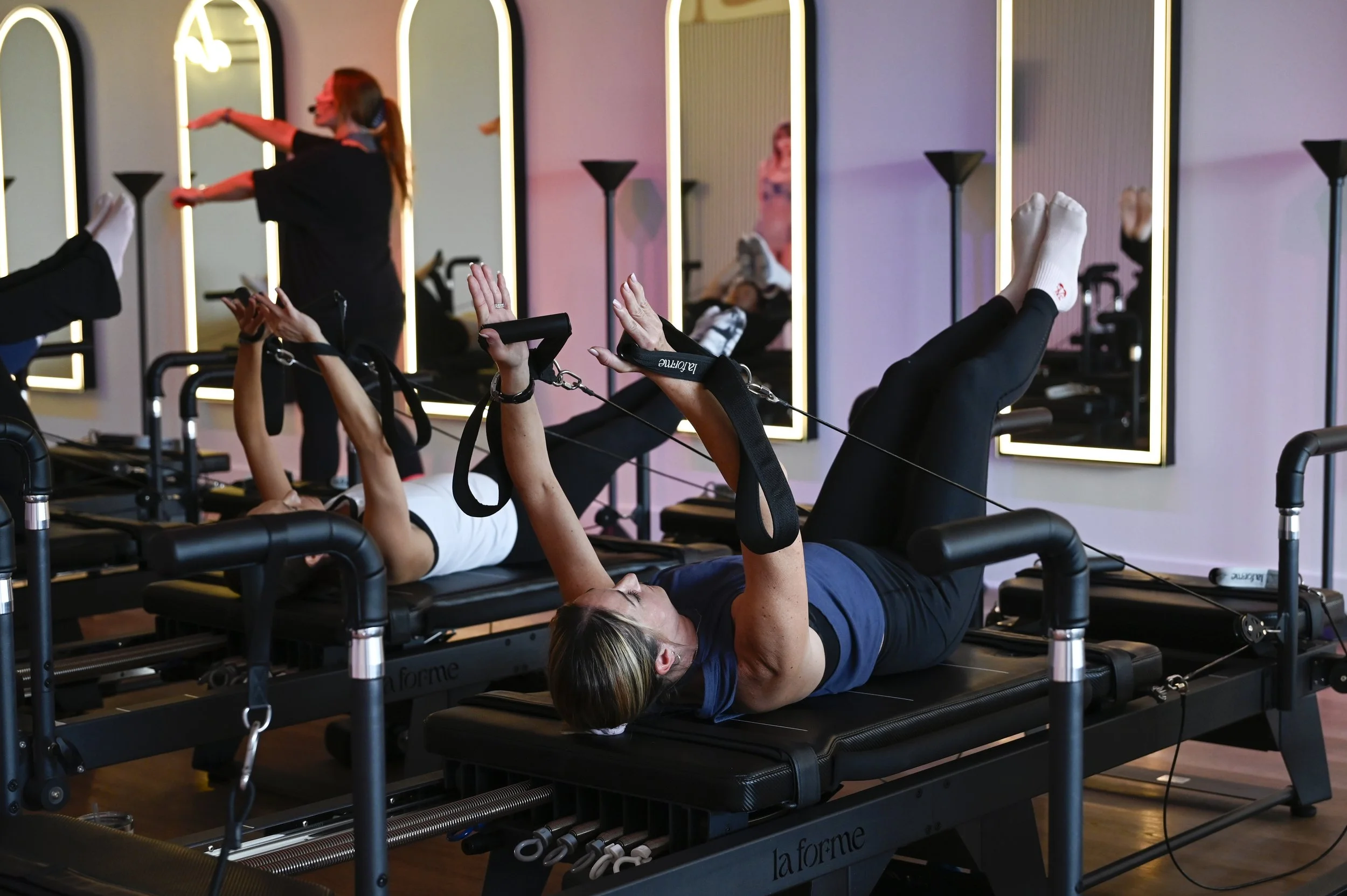
Modern reformer Pilates is one of the cleanest examples of this category. The slow, controlled tempo recruits slow-twitch muscle fibers that traditional cardio rarely fatigues. The continuous spring resistance keeps muscles under tension for longer, which is the actual driver of strength adaptation. And the reformer itself supports your spine, shoulders, and joints while you work, so you can train hard without paying for it tomorrow.
Five specific things this kind of training does for a body over 35
1. Builds and preserves lean muscle
Resistance training is the only intervention shown to reverse sarcopenia. Slow, loaded, time-under-tension work (the reformer's specialty) is particularly effective at recruiting and developing the muscle fibers that age tends to neglect.
2. Protects bone density
Loaded movement signals your skeleton to maintain itself. Reformer Pilates loads bones through resistance and weight-bearing positions, which research consistently links to slower bone loss and reduced fracture risk later in life.
3. Manages cortisol instead of spiking it
A 50-minute, focused, breath-paced session keeps your nervous system in a productive zone. You leave class energized rather than wrecked. For a body already managing a high stress load, this is the difference between a workout that helps and one that compounds.
4. Supports hormonal shifts (perimenopause, andropause)
Resistance training, deep core work, and strength-and-mobility integration all support the changes that happen through perimenopause and into menopause. They also support healthy testosterone in men in the same age band. The reformer gives you all three in one session.
5. Improves the things you actually use your body for
Picking up a kid without bracing. Carrying groceries in one trip. Sitting through a long workday without your back tightening. Sleeping deeper. Standing up from the floor without using your hands. The reformer trains the small stabilizers and deep core that make these everyday movements feel easier, which is the actual definition of fitness in this decade.
What this looks like at La Forme
Our 50-minute classes are designed exactly for this body and exactly for this stage of life. Slow, deliberate movement on the megacore reformer. Continuous resistance through every range of motion. Small class sizes so your instructor can actually see you and adjust your form. A studio environment built to feel like a pause from the day rather than another item on the calendar.
Most members feel stronger within two weeks. Visible change, the kind you notice in the mirror and in the fit of your clothes, typically shows up around 6 to 8 weeks for those attending 2 to 3 classes per week. We have members in their teens, 20s, 30s, 40s, 50s, 60s, and beyond, training side by side, each at their own resistance and pace. We love seeing women of every generation working out side-by-side.
If you have been searching for a workout that meets the body you have now (not the body you had ten years ago), this is the category to explore.
Try it for yourself
Our Introduction Offers are how most members start: 3 classes for $59 (Curious) or 8 classes for $160 (Committed). Eight classes is where most people start to feel the shift.
Book your first class at laformepilates.com/schedule, or visit us at 1167 Colonnade Center in Des Peres.